Research tools for the health sciences

Research you can verify, from the first question to the final report.

Three divisions, one standard. Plan, analyse and write your study; assess and report adverse drug reactions; and run genetic association studies. Every figure is calculated by tested methods and every citation is traced to a published source you can open.

  • Values quoted from published papers
  • Calculations by tested formulas
  • No patient-identifiable data required
Animation of the sample size assistant: the study design, a published prevalence of 49.8% highlighted in an abstract, the sample size counting up to 428 over a bell curve, sliders for margin of error and drop-out changing the result, the participants and a finished Word report.Sample sizen = 428Cross-sectional · single proportion49.8% prevalenceWADJUSTMargin of error5.0%Drop-out10%
Divisions

One platform, three areas of expertise

Choose the division for your work. Each follows the same standard: published methods, checked numbers and sources you can verify.

How it works

Four steps from your details to a finished document

  1. Step 1

    Enter your details

    Your topic and objectives, a suspected reaction, or genotype counts. Upload a document or a sheet where you have one. Never a patient's name or hospital number.

  2. Step 2

    Pay once

    A search, or a fixed price for the study. The full price (with 18% GST for India) is shown before you pay, and a run that fails on our side is not counted.

  3. Step 3

    Check the evidence

    Every value shows where it came from: the sentence in a published abstract, the formula with its working, or the scale and its answers.

  4. Step 4

    Download

    Word, Excel, PDF or PowerPoint, laid out and ready for your guide, committee or journal. Your work stays in your account.

Sample outputs

See the quality before you begin

Real result screens from the tools, made with sample data. See all 21 on the sample outputs page.

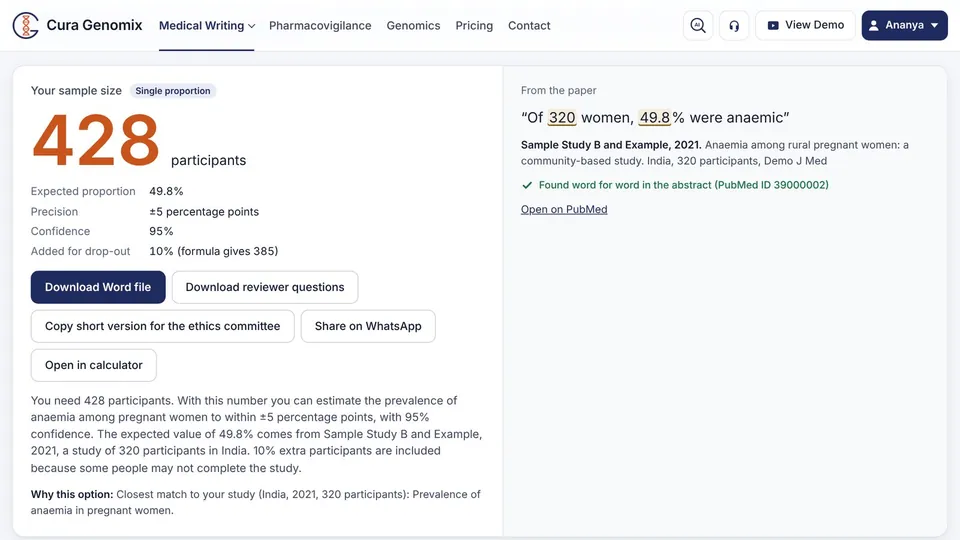
Sample size result showing 428 participants, the quoted sentence from the paper and download buttons
Medical Writing

Sample size write-up

Result
428 participants
Evidence
Value quoted from a published abstract
Files
Word, reviewer questions
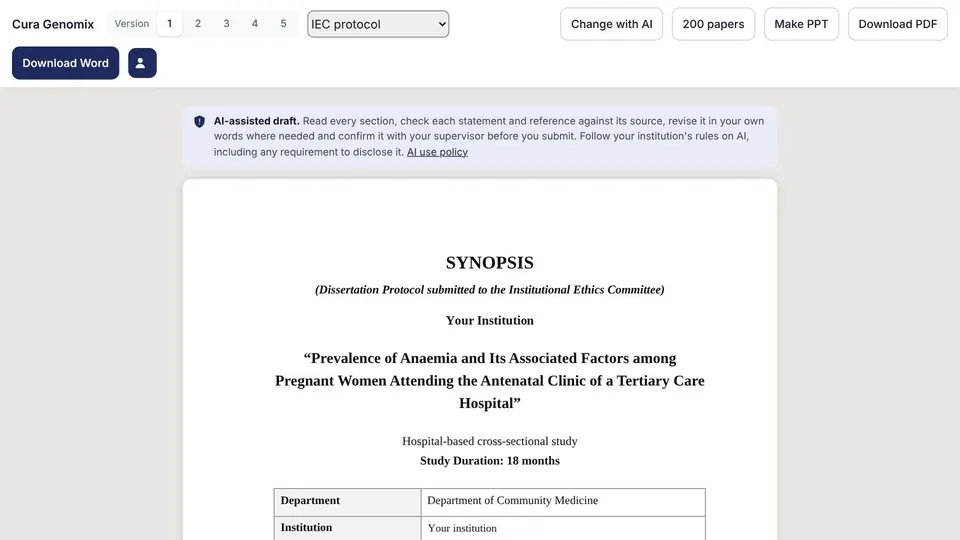
The first page of a drafted synopsis in the ethics committee format
Medical Writing

Study protocol (synopsis)

Result
5 versions to choose from
Evidence
12 references from PubMed
Files
Word, PDF
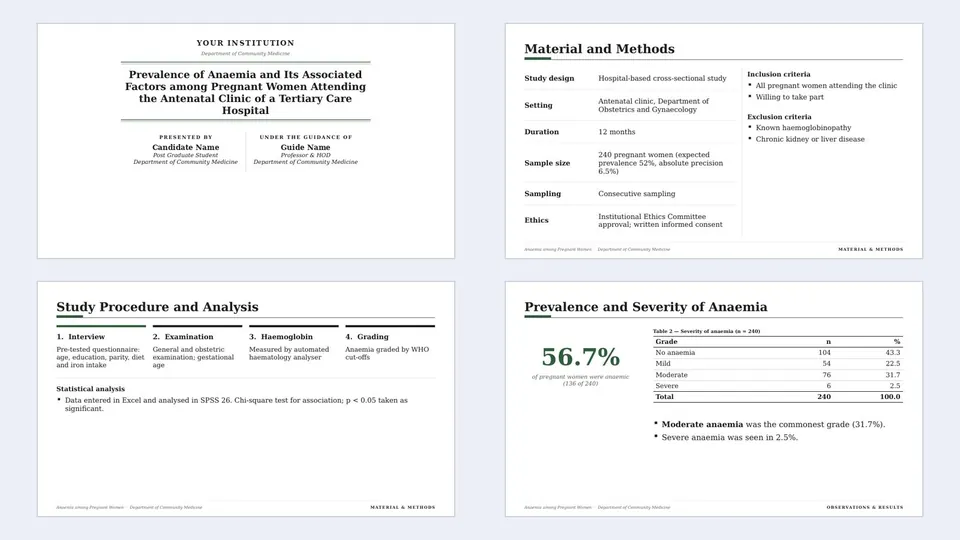
Four slides of a generated presentation: title, methods, procedure and results
Medical Writing

Presentation and poster

Result
Editable slides and an A0 poster
Evidence
Numbers checked against the report
Files
PowerPoint
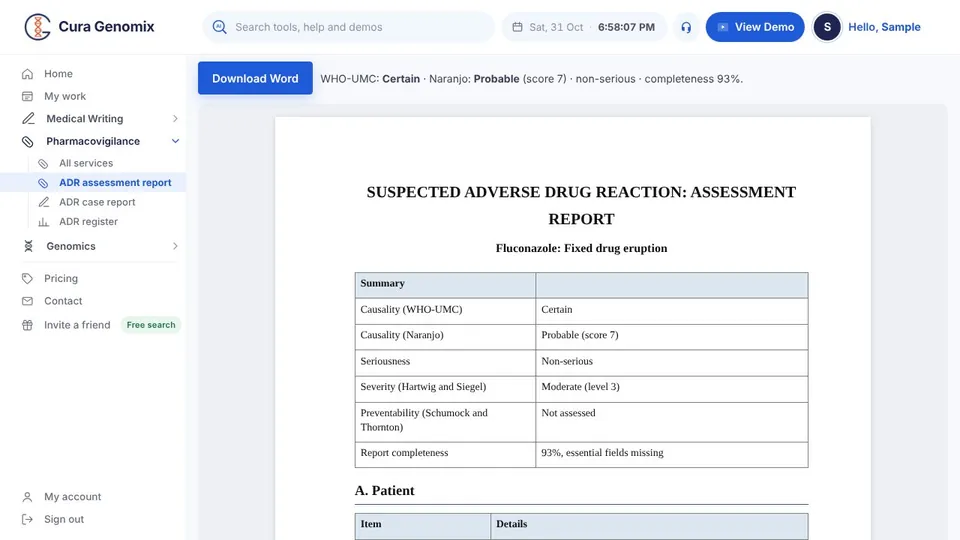
ADR assessment report summary: WHO-UMC certain, Naranjo probable, non-serious, moderate severity
Pharmacovigilance

ADR assessment report

Result
WHO-UMC certain; Naranjo probable (7)
Checks
Completeness for PvPI reporting
Files
Word
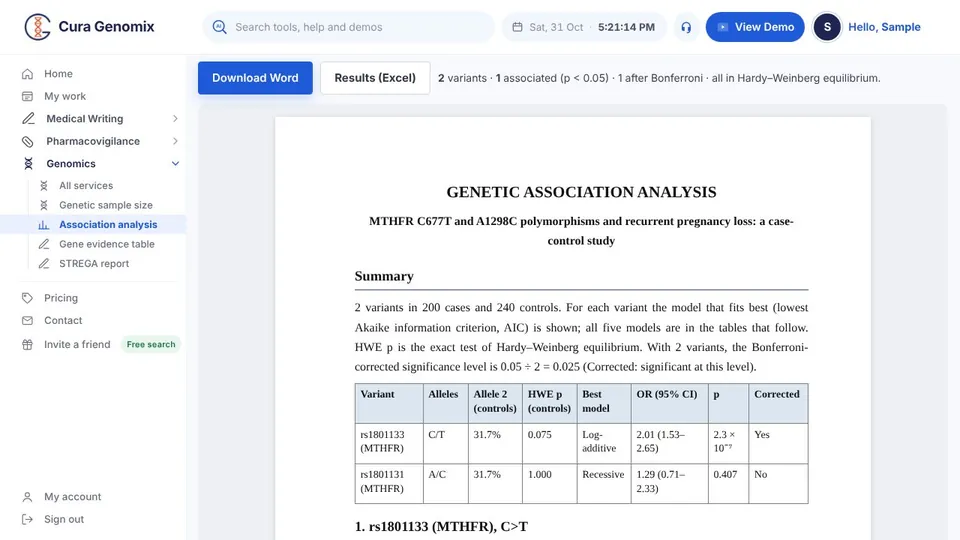
Genetic association summary for two MTHFR variants with odds ratios and p-values
Genomics

Genetic association analysis

Result
Odds ratios under five genetic models
Checks
Hardy–Weinberg equilibrium, exact test
Files
Word, Excel
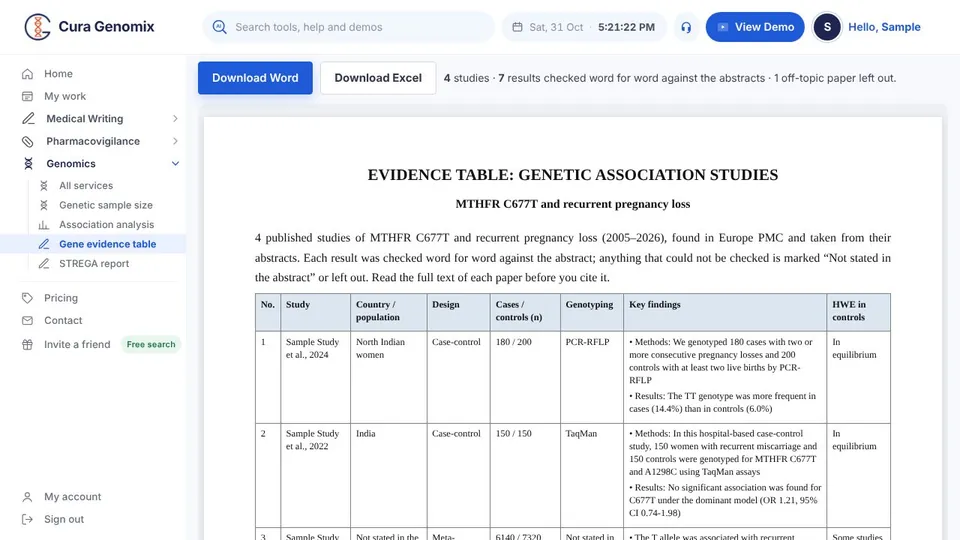
Evidence table of published studies of MTHFR C677T and recurrent pregnancy loss
Genomics

Gene and variant evidence table

Result
Published studies in one table
Evidence
Every number checked against the abstract
Files
Word, Excel

View all sample outputs

The difference

Built for research, not general conversation

General-purpose chatbots write fluently, but research documents must withstand scrutiny from supervisors, ethics committees and peer reviewers.

FeatureGeneral AI chatbotCura Genomix
ReferencesCan be inventedBuilt from Europe PMC, PubMed, OpenAlex or Semantic Scholar records
NumbersCan be estimatedQuoted word for word from the abstract, then checked
ArithmeticDone by the language modelDone by tested formulas
Scales and testsApplied from memoryPublished scales and statistical methods, with the working shown
FormatPlain textYour institution's format, in Word, Excel and PDF
Your workLost in a chat historySaved securely in your account
Why Cura Genomix

Why researchers choose Cura Genomix

Designed by a medical statistician who works alongside clinical researchers every day, around the questions that ethics committees and reviewers actually ask.

Traceable to the source

Every value and reference links to a published record that you can open and check.

Validated calculations

Calculations follow published statistical methods and are checked against worked examples and hand calculations.

Your data stays private

No patient data is required, uploaded files are not stored, and you can delete your work at any time.

Transparent about limitations

When the evidence is limited or the number of participants is small, the output says so clearly rather than adjusting the numbers.

Built for research integrity

Cura Genomix prepares drafts. You review them, you remain the author, and you follow the rules that apply to your work. Read the AI use policy.

  1. Every claim has a source. References come from database records, never from the AI's memory.
  2. Your institution's rules come first. Check what your university, ethics committee or journal allows before you use AI tools.
  3. Disclose AI assistance. Where the rules ask for it, say that you used Cura Genomix.
Pricing

Transparent pricing, no subscription

Pay per search for the everyday tools, or a fixed price per study for the larger ones. Prices are shown before you pay; searches never expire.

Search packs for the sample size assistant and calculator, literature finder, results checker, presentation maker and manuscript writer (2 searches)

1 search

₹99₹99 a search

One study

Most chosen

5 searches

₹399₹79.80 a search

A few studies

10 searches

₹699₹69.90 a search

Several studies

Institution pack

₹5,999100 searches, ₹59.99 each

A team or department, with a GST invoice

Fixed price per study one payment covers one study, with several runs to correct and make it again

18% GST is added at the payment step. Pay by UPI, card or net banking through Razorpay. See pricing details

Prices for students outside India are in US dollars, with no GST added. Pay by international card through Razorpay. See pricing details

One account for your whole team

The institution pack provides 100 searches in a single account, with a GST invoice issued in the institution's name. We can also arrange a short online session on study planning for your team.

Talk to us

Looking for a service that is not yet available?

Grant proposals and other services are in development. Tell us what you need and we will let you know when it opens.

Send a request
Help

Common questions

How are the tools charged?

Every tool is paid. The sample size assistant, the literature finder and the presentation maker use one search per topic, with its edits and downloads, and the manuscript writer two; the calculator and the results checker each open for 24 hours with one search. The larger tools have a fixed price per study, shown before you pay: the synopsis writer (₹799, with its PowerPoint), data analysis, the thesis and conference writers, the analysis plan, evidence table, response to reviewers and systematic review support, and every Pharmacovigilance and Genomics tool.

What if a search fails?

If it stops because of a problem on our side, the search returns to your account automatically.

Are the references real?

Yes. Each one is built from a Europe PMC, PubMed, OpenAlex or Semantic Scholar record, and you can open the paper. Values used in a sample size are quoted word for word from the abstract.

Can the AI make up a number?

The system is built to prevent it: a value is used only if the sentence it came from appears word for word in the abstract, and all arithmetic is done by tested formulas. AI can still misread a study, so always check the source before you rely on a value.

Can I submit the output as it is?

No. It is a draft: check every value and reference, revise it in your own words where needed, confirm it with your supervisor, and disclose AI assistance where your institution requires it. You remain the author.

Is my text used to train AI?

No. Our AI provider processes it under commercial terms that exclude training. Please never enter anything that could identify a patient or participant. See the privacy policy.

Which files do I get?

Word and PDF for documents, PowerPoint for presentations and posters, and Excel for paper lists, tables, ADR line listings and genetic results.

Does the ADR assessment replace the PvPI reporting form?

No. It applies the WHO-UMC and Naranjo scales and checks the details PvPI needs, so you can fill in the official form completely. The assessment supports clinical judgement; the reporting healthcare professional remains responsible for it and for reporting to the ADR Monitoring Centre.

Do I upload genetic data?

Only if you choose to, and even then it stays on your computer: a sheet of individual genotypes is counted in your browser, and only the genotype counts are saved. Do not include names or anything that identifies a participant. The Genomics tools are for research use only.

Which reference style is used?

Numbered (Vancouver) references today. APA and Harvard are planned.

Can my department share one account?

Yes, with the institution pack of 100 searches. Ask for an invoice.

Can I get a refund?

Searches are not refunded in money, and unused searches never expire. A search that fails or goes wrong because of an error on our side is returned to your account. See the refund policy.

What if only a limited number of participants is available?

In the calculator, choose “What my patients allow”. It works out the precision or power that number gives and writes it up as a limitation, instead of changing your inputs.

How do I reach support?

Use the contact form, email [email protected] or call +91 80042 41247, Monday to Saturday, 10 am to 6 pm. We reply within 2 working days.
Start your next study with confidence.

Medical writing, pharmacovigilance and genomics, in one account. Pay only for what you use.